Community radio is what gives Australia its diverse
culture in the broadcasting realm. A quarter of Australian radio listeners tune
in to one or more of the 362 licensed community radio stations around the
country each week.
Controlled and regulated by the Community Broadcasting Association of Australia, and generally
being non-for-profit organisation and run voluntarily by the community
themselves, community radio stations have the opportunity be specific in what
they provide. Giving their local communities a voice on the air by covering
niches that include alternative music and arts, youth and senior services, Indigenous,
ethnic and religious communities, educational services, and reading services
for the print disabled.
The campaign ‘Commit to Community Radio’ was
created to support a digital future for community radio. Community radio
stations across Australia are asking for help and support to ensure that they
have an ongoing future. Community radio stations support many of their means
with self funding, but cannot support the conversion and transmission of
digital radio.
The campaign is asking for the voices of community
radio listens to speak up to the government to ensure that community radio will
indeed have a future.
I contacted a few community radio stations around
Victoria, asking why their stations needed to continue andn what the negative
implications would be if their stations lost funding for continuation, and
received response from PBS, Triple R, 3MBS, and RPH Australia. All spokespersons stated
similar facts: they cannot raise enough money for the connection and
transmission to digital radio themselves and feel that communities will be
underrepresented as a result.
The
way the world is headed, analogue systems are on the way out with digital
taking over. The general assumption is that this is a good thing.
Digital transmission means community radio would
have secure spot in Australia’s future. So far the government has funded enough
money to cover 37 metropolitan wide community radio stations conversion to
digital radio under the Digital Radio Project.
But
alas! The government is not willing to provide enough funds for the conversion
and continuation of all community radio stations.
“The Federal Government determined some time ago that Australia would
move our free-to-air radio broadcasting to a new digital format. That
format is DAB+. The infrastructure required to broadcast via this new
system is very expensive and the costs associated are far beyond the reach of
any individual community radio station.” - Owen McKern, PBS.
“We responded
to the government’s encouragement to set up to broadcast as well on the DAB+
platform. We and other stations were not in a position to increase our ongoing
revenue base sufficiently to meet the costs of broadcasting on the 2 platforms” - Anne Frankenberg, 3MBS.
With the intention of allocating a budget $1.4
million less then the minimum requirement for all community radio stations to
continue into the digital realm.
“As a radio for
the Print Handicapped (RPH) radio station, our license restricts the available
time we are able to air sponser announcements, hence our ability to raise
revenue” - Lynnette Mills, RPH.
“Federal government funding for
community digital radio supports ONLY the transmission and connectivity costs
for digital radio services managed through the Community Broadcasting
Association of Australia’s Digital Radio Project on behalf of the current 37
stations” - Zoran Ilievski, Triple R.
“That funding assistance will allow community stations around Australia
to access the infrastructure needed for broadcasting via digital radio…. Without
a full presence on digital radio, PBS and community stations around Australia
will be relegated to minor players in our media landscape. This will
significantly diminish the public’s access to diverse, independent and
specialist content” - Owen McKern.
“If community
stations like PBS do not have access to digital radio services then we will
only have a presence on the Internet via streaming radio and
audio-on-demand. It should be emphasized that web streaming is NOT radio,
nor is it free-to-air” - Owen McKern.
In reality many community radio stations will have
to shut their doors, as they will not be able to afford the change over.
“The issue is
that the government has not met its undertaking to underwrite these additional
costs for the community radio sector… The long-term impact may be that if FM is
ultimately replaced as the key free-to-air broadcast medium, the community
stations may be left with no broadcast platform” - Anne Frankenberg.
Thanks
to my Dad, I was raised on community music stations and spent many days and
nights with my radio, creating a still-living love affair. One specific memory
of my childhood involved connecting every extension cord we owned together,
dragging the lengthy chain up a tree, plugging in my radio, and proceeding to
spend hours up a tree singing along or listening to whatever rambles were going
on in the world. Nothing made me happier then listening to community radio.
“Community
radio is largely about providing a voice to the otherwise underrepresented,
whether that be talks or music, and for me that means a free-to-air broadcast
option is an absolute must” - Zoran Ilievski.
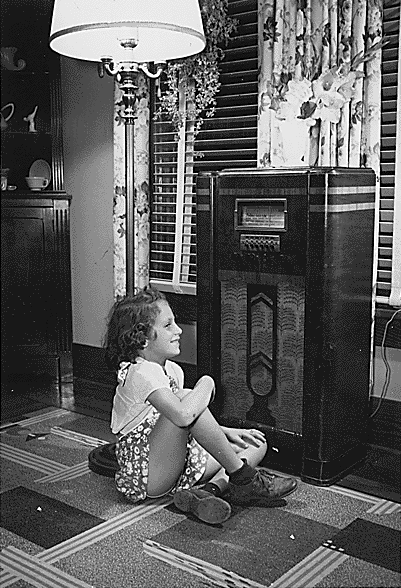
(By Franklin D. Roosevelt Library Public Domain Photographs [Public domain], via Wikimedia Commons)

