Monday, 3 June 2013

Love locked forever.

Love padlocks have been appearing around Europe since the early 2000’s. Why this newly formed custom has taken off, well no one really knows. The tradition is thought by some, to have originated in China. But in the romantic city of Rome, Italy, romantic sweetheats have been influence by the book ‘I Want You’ by Italian author Federico Moccia. His novel features a young couple attaching a lock to Rome’s Milvian Bridge as a sign of eternal love.

Love padlocks maintain the same basic idea around the world. Newly wedded couples attach padlocks to bridges to bring secure their love and their new lives together. Couples attach padlocks for good luck for their love. Some couples attach padlocks as purely a symbol of their love.


However, these sweethearts taking part in the newly adored custom of love is make sure their names are together forever. Engraving their initials into the lock before throwing away the key to remain lost for eternity, and hopefully their love will last just as long.


As referenced in Moccia's story, love padlocks on the Ponte Milvio, a bridge over the Tiber in Northern Rome, Italy.

By heb@Wikimedia Commons (mail) (Own work) [CC-BY-SA-3.0 (http://creativecommons.org/licenses/by-sa/3.0)], via Wikimedia Commons


Travelling for love? Take a look at this romantic feature on love padlocks around the world.


Thinking of visiting Helsinki? Get the run down on what you need to know here.

Travelling for romance?

Romance is often the reason for travelling. Couples flying half way across the world to celebrate their connections, marriages, or because they just want to get away. They main point of the matter is that they are in love.

Love padlocks are a custom in which couples affix a padlock to a fence, gate, or bridge (any public space over water) and throw the key into the surrounding rivers and lakes to symbolize their everlasting love.

This custom has taken off around the world. Sweethearts have been founded declaring their love from Europe to Asia to Australia, affixing padlocks to their cities structures.


Love padlocks covering a bridge in Prague, Czech Republic.

By Matěj Baťha [CC-BY-SA-3.0 (http://creativecommons.org/licenses/by-sa/3.0)], via Wikimedia Commons


Mount Huang, a bridge in the mountain range of southern Anhui province in eastern China.

By Yabbox (Own work) [CC-BY-SA-3.0 (http://creativecommons.org/licenses/by-sa/3.0) or GFDL (http://www.gnu.org/copyleft/fdl.html)], via Wikimedia Commons


A purpose built iron trees situated on the Vodootvodny Canal in Moscow

By A.Savin (Own work) [GFDL (http://www.gnu.org/copyleft/fdl.html) or CC-BY-SA-3.0-2.5-2.0-1.0 (http://creativecommons.org/licenses/by-sa/3.0)], via Wikimedia Commons


Most Liubavi ‘The Bridge of Love’ in Vrnjacka Banja, Serbia.

AcaSrbin, Panoramio [CC-BY-SA-3.0 (http://creativecommons.org/licenses/by-sa/3.0)], via Wikimedia Commons


Love padlocks covering a bridge in Donetsk, Ukraine.

By MOs810 (Own work) [CC-BY-SA-3.0 (http://creativecommons.org/licenses/by-sa/3.0)], via Wikimedia Commons


If your reason for travel is romance, AirBnB is the perfect place to organize accommodation. With many residencies around the world, you can find the perfect place for your romantic getaway near any of these love padlock locations, and more.

Would you prefer a vintage feel to your stay? Have a gander at these rooms.

Maybe you and your partner are feeling a bit King and Queen-ish (or Queen and Queen-ish, King and Kin-ish, love it love after all!). These castles will provide you with your throwns. 

Or maybe (like me) your partner is just a little on the odd side. These places are perfect for the left-of-centre personalities.


Visit AirBnB for more information.


10 things to know about Helsinki before you visit.

 A handy-help list.

       By Zyance (Own work) [CC-BY-SA-2.5 (http://creativecommons.org/licenses/by-sa/2.5)], via Wikimedia Commons

1. 
Helsinki is the largest city of Finland, located in the region of Uusimaa. Finland is located approx. 80 kilometres north of Tallinn, Estonia, 400 kilometres east of Stockholm, Sweden, and 300 kilometres west of Saint Petersburg, Russia.

2.
Helsinki’s time zone is Eastern European Time (EET) and runs two hours ahead of the Coordinated Universal Time (UTC+2). In Summer, time runs an hour faster (UTC+3).

3.
The weather in Helsinki varies greatly from season to season.
In Summer, days last the longest with 19 hours of sunlight. Its warmest month is June, with an average temperature of +21.7 degrees celcius.
In Winter, days are the coldest. Starting somewhere between November and December, temperatures fluctuate around 0 degrees celcius. The average temperature for Winter is -10.4 degrees celcius.

4.
Chances are you caught a plane into the country. Helsinki is accessible from anywhere in the world. Approx. 200 planes arrive at Helsinki’s airport, Helsinki-Vantaa Airport, from all over the world. To get out of the airport, a 25 minute car ride can be taken to the centre of town. Alternatively there is the airport bus, the bus 615 will take you to the Central Railway Station, or a taxi will set you back around 35-40 Euros.

5.
To travel around Helsinki, there are a few different tickets but the most useful would be the dayticket. They provide unlimited use on public transport for a duration of 1-7 days. Check out this link for more information.

6.
 The Helsinki Region Tourist Information desk is at the Helsinki-Vantaa Airport, providing information for tourists upon arrival. Located in Arrival Hall 2 A inside Terminal 2, the information point is open every day from 10am to 8pm.

7.
Once you are in Helsinki, the Helsinki City Tourist & Convention Bureau’s Tourist Information is open to provide information to tourists about the city, events, sights, maps, and brochures. The tourist information centre is open:
Summer:
Monday to Friday 9am to 8pm, Saturday and Sunday 9am to 6pm
Winter:
Monday to Friday 9am to 6pm, Saturday and Sunday 10am to 4pm

8.
Roaming the streets of Helsinki from the months of June to August are the Helsinki Helpers. They are there to provide lost tourists with maps, brochures, and relevant happenings. They travel in pairs and wear fluro green vests; you’ll see them from a mile away.

9.
Have no idea what to do? Here is an easy access website for what is happening in Helsinki. Type in your dates of travel here and have a gander at what is around.

10.
The last tidbit of information, something you may never think of. The general assumption when you travel is that you won’t fall into any dangerous situations, you won’t hurt yourself, really you’ll just be safe and fine the whole time. But we all know things can turn soul in the shortest amount of time, so just in case. Emergency telephone numbers:
General emergencies 112
Police, ambulance and fire 112


Curiosity still running high? Check out Helsinki's Tourist Website for more information. 


Tuesday, 30 April 2013

Commit to Community Radio


Community radio is what gives Australia its diverse culture in the broadcasting realm. A quarter of Australian radio listeners tune in to one or more of the 362 licensed community radio stations around the country each week.

Controlled and regulated by the Community Broadcasting Association of Australia, and generally being non-for-profit organisation and run voluntarily by the community themselves, community radio stations have the opportunity be specific in what they provide. Giving their local communities a voice on the air by covering niches that include alternative music and arts, youth and senior services, Indigenous, ethnic and religious communities, educational services, and reading services for the print disabled.

The campaign ‘Commit to Community Radio’ was created to support a digital future for community radio. Community radio stations across Australia are asking for help and support to ensure that they have an ongoing future. Community radio stations support many of their means with self funding, but cannot support the conversion and transmission of digital radio.

The campaign is asking for the voices of community radio listens to speak up to the government to ensure that community radio will indeed have a future. 

I contacted a few community radio stations around Victoria, asking why their stations needed to continue andn what the negative implications would be if their stations lost funding for continuation, and received response from PBS, Triple R, 3MBS, and RPH Australia. All spokespersons stated similar facts: they cannot raise enough money for the connection and transmission to digital radio themselves and feel that communities will be underrepresented as a result.

            The way the world is headed, analogue systems are on the way out with digital taking over. The general assumption is that this is a good thing.

Digital transmission means community radio would have secure spot in Australia’s future. So far the government has funded enough money to cover 37 metropolitan wide community radio stations conversion to digital radio under the Digital Radio Project.

             But alas! The government is not willing to provide enough funds for the conversion and continuation of all community radio stations.

“The Federal Government determined some time ago that Australia would move our free-to-air radio broadcasting to a new digital format.  That format is DAB+.  The infrastructure required to broadcast via this new system is very expensive and the costs associated are far beyond the reach of any individual community radio station.” - Owen McKern, PBS.

“We responded to the government’s encouragement to set up to broadcast as well on the DAB+ platform. We and other stations were not in a position to increase our ongoing revenue base sufficiently to meet the costs of broadcasting on the 2 platforms” - Anne Frankenberg, 3MBS.

With the intention of allocating a budget $1.4 million less then the minimum requirement for all community radio stations to continue into the digital realm.

“As a radio for the Print Handicapped (RPH) radio station, our license restricts the available time we are able to air sponser announcements, hence our ability to raise revenue” - Lynnette Mills, RPH.

 “Federal government funding for community digital radio supports ONLY the transmission and connectivity costs for digital radio services managed through the Community Broadcasting Association of Australia’s Digital Radio Project on behalf of the current 37 stations” - Zoran Ilievski, Triple R.

“That funding assistance will allow community stations around Australia to access the infrastructure needed for broadcasting via digital radio…. Without a full presence on digital radio, PBS and community stations around Australia will be relegated to minor players in our media landscape.  This will significantly diminish the public’s access to diverse, independent and specialist content” - Owen McKern.

“If community stations like PBS do not have access to digital radio services then we will only have a presence on the Internet via streaming radio and audio-on-demand.  It should be emphasized that web streaming is NOT radio, nor is it free-to-air” - Owen McKern.

In reality many community radio stations will have to shut their doors, as they will not be able to afford the change over.

“The issue is that the government has not met its undertaking to underwrite these additional costs for the community radio sector… The long-term impact may be that if FM is ultimately replaced as the key free-to-air broadcast medium, the community stations may be left with no broadcast platform” - Anne Frankenberg.

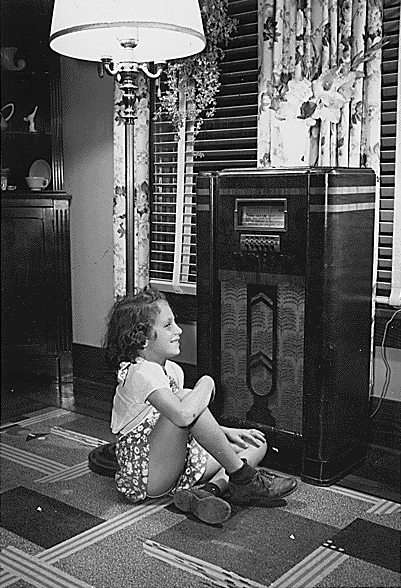
            Thanks to my Dad, I was raised on community music stations and spent many days and nights with my radio, creating a still-living love affair. One specific memory of my childhood involved connecting every extension cord we owned together, dragging the lengthy chain up a tree, plugging in my radio, and proceeding to spend hours up a tree singing along or listening to whatever rambles were going on in the world. Nothing made me happier then listening to community radio.

“Community radio is largely about providing a voice to the otherwise underrepresented, whether that be talks or music, and for me that means a free-to-air broadcast option is an absolute must” - Zoran Ilievski.

(By Franklin D. Roosevelt Library Public Domain Photographs [Public domain], via Wikimedia Commons)

Friday, 22 March 2013

Saturday morning

is Rage time for my father and I. Has been since I was about 5, making that approx. 19 years.
As soon my mother leaves, the telly is turned up so that the whole neighbourhood can par-take in out Saturday morning ritual.
We dance and judge and do a running commentary.
Best.

Thursday, 21 March 2013


All the colours of the beer rainbow that Falls '11-'12 provided =D

Dancing with the Cows.


Over the last 3 years, attendance of the Groovin' the Moo festival has been a social must amongst my 'festy mates' (a name taken from our love of Festival 'Festy' Hall). This year, our fourth year, is no less the same.


All the same pre-planning has been going on; who's driving, who's drinking, can we agree on  a dress theme, are we meeting up on the Calder because we know none of us has any sense of direction and doesn't think to follow the others, will we stupidly allow beer in the car on the way up knowing damn well the bottles will end up smashed alongside the highway resulting in mass screaming, and most importantly... what will we be listening to during the ride up? Knowing the drive will take us around 5 hours, these are very important things.

All this aside, this year a band that my dear friend and myself hold to heart will be playing: 

Tame Impala: the epitome of 60's psychedelic revival. And the need to take a spare pair of pants.

With this open love affair in mind, we haven't actually seen them live yet, leaving thrill and delight to run high as the 4th of May approches. The thought of mindlessly dancing around a field, forgetting our surroundings, imagining that we're in London 1966, waiting for the Psychedelic Sounds of the 13th floor elevators to headline...(all in our dreams of course!) we're just going to be VERY excited young ladies who are FINALLY dancing together to our future husbands. I mean... Tame Impala. 

Bendigo hold onto your pants, we will see you soon. 

Groovin' the Moo tickets are actually sold-out. But check out the wicked-as line-up anyway:

The start of a blog that I may or may not attend to on a regular basis

So i'm Chloe. I'm a writing student, but my openly secret love is live music, and being in close proximity with my mates in loud and sweaty situations.

You'd be surprised how close you can become with someone when you meet them in such a setting.

Anyway, you'll find this blog to be about music things and live music things and such. Possibly a side of books too, depending on how i'm feeling.

Enjoy!